The Philippines has set out to more than double its semiconductor and electronics exports to USD 110 billion a year by 2030. The new roadmap behind that goal reads like an export plan, but in our view it is mainly a plan about engineers.
What the roadmap sets out
The PSEI Roadmap is a five-year plan for 2026 to 2030, led by the Department of Trade and Industry (DTI) through the Board of Investments (BOI). SEIAC, chaired by Executive Secretary Ralph Recto, oversees its execution. Its main commitments:
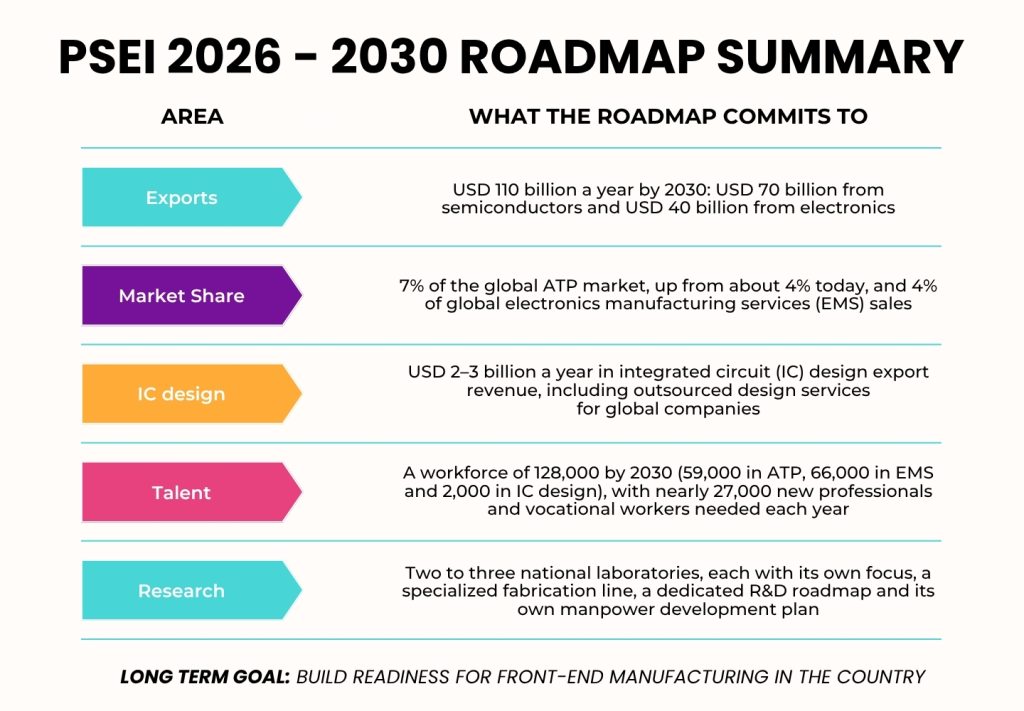
Source: 2026–2030 PSEI Roadmap
The starting point is strong. According to the roadmap, semiconductor and electronics exports reached USD 49.6 billion in 2025, up 16.2% from USD 42.7 billion in 2024. The sector has consistently accounted for over 60% of the country’s total merchandise exports. In September, the industry raised its 2026 export growth forecast to 10%, which could push exports past USD 50 billion for the first time.
Still, reaching USD 110 billion means more than doubling exports in five years. Recto has said that without clear timelines and monitoring, the plan “is just paper with ambition printed on it”.
Why the roadmap depends on engineers
The roadmap’s own framing puts design and engineering at the center. At the launch, Executive Secretary Ralph Recto, who chairs SEIAC, said the goal is not only to see “Made in the Philippines” on products, but “Designed in the Philippines. Engineered in the Philippines. Innovated in the Philippines.”
“We have built the world’s electronics for fifty years. This Roadmap charts how we come to design them.”
— Victor Gruet, Vice President, Electronics Industry Association of the Philippines Inc. (EIAPI), and Director, Weave Solutions
Every step up the value chain in the roadmap, from advanced packaging to IC design to front-end manufacturing, needs more engineers with deeper skills. The industry says so directly. Philippine Chamber of Commerce and Industry (PCCI) President Ferdinand Ferrer has said sustained growth requires moving beyond assembly, testing and packaging into chip design and other higher-value work.
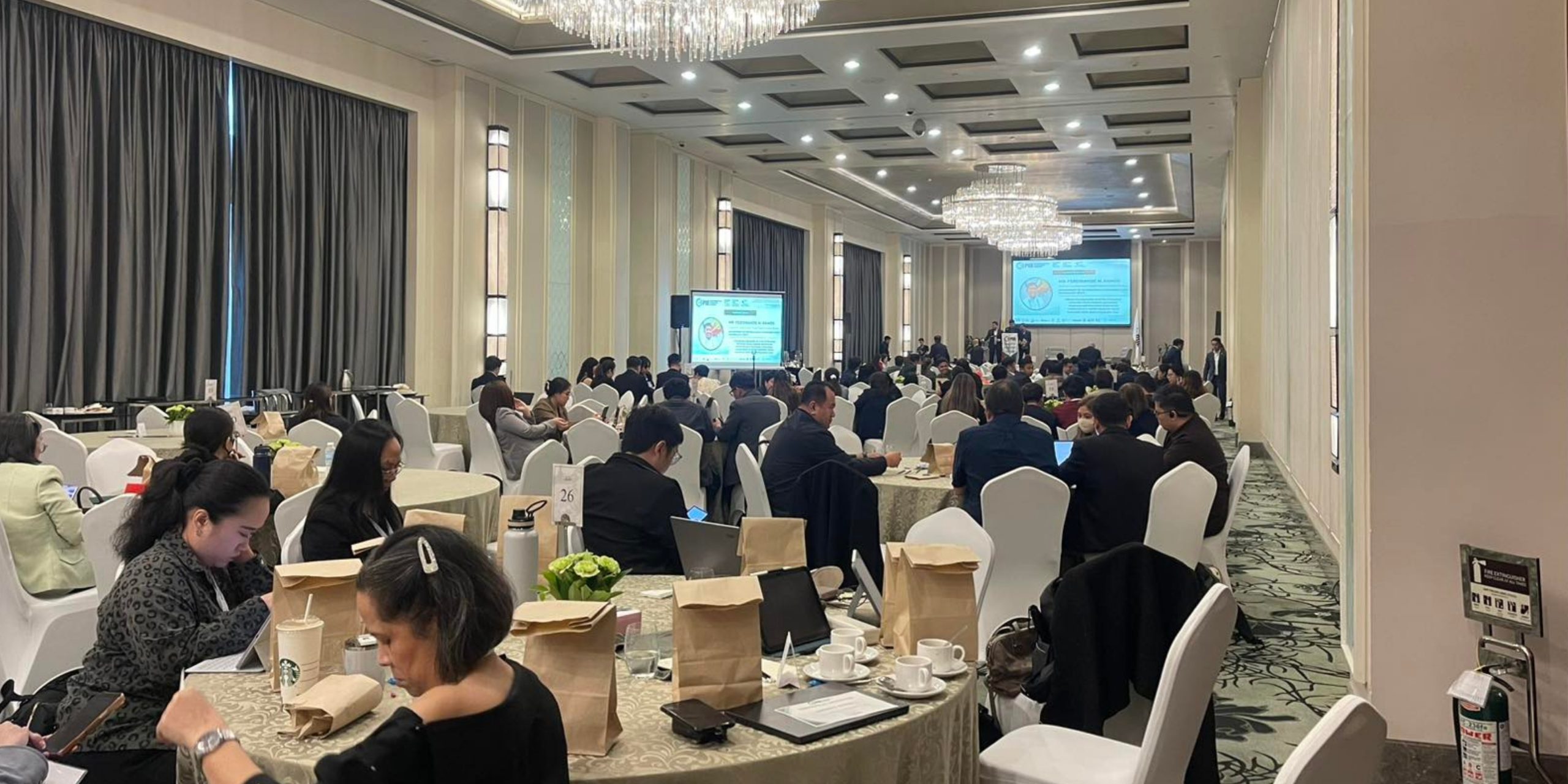
At a May 2026 forum organized by the Philippine IC Design Association, participants said the main obstacle is a fragmented ecosystem, not a lack of engineering talent. They pointed to limited access to industry-grade design tools, too few specialized faculty and weak coordination of the STEM pipeline.
The roadmap itself is candid about this. It calls talent “a critical competitive disadvantage” and estimates that 87% of local electronics engineers need significant retraining. It also notes that senior IC design engineers are often hired away by foreign companies offering higher pay and more valuable work.
How global electronics companies already use Filipino engineering teams
While the roadmap works on the national pipeline, international electronics companies are not waiting. In our work with electronics and embedded systems clients, we see a consistent pattern: Philippine engineering teams handle a growing share of the work that keeps global product lines moving.
The roadmap names some of them. Analog Devices and Rohm run IC design centers in the country, and Analog Devices invested USD 200 million in a new one in 2023. Local firms such as Xinyx and Embedded Silicon provide design services to global fabless companies. One of the roadmap’s four missions is to “provide reliable, innovative, and cost-effective outsourced IC design services.”
Typically, that work includes:
- Design support: electrical design, PCB and component engineering, and mechanical design
- Embedded and firmware development: often for products sold and supported in several regions
- New product introduction (NPI): taking designs from prototype to production
- Test and validation: clearing the bottlenecks that delay releases
- Documentation and compliance: work built around IPC, EMC and ISO standards
What makes this work is not lower cost alone. These teams sit inside the client’s own workflows and reporting lines. They work with engineering leads in other countries and carry ongoing responsibility for parts of the product line, not one-off tasks.
The honest counterpoint: the Philippines is not the only option. Neighboring economies are competing hard for the same semiconductor investment, and the IC design talent pipeline is still being built. Companies that do well here plan for this. They hire for niche roles early, invest in onboarding, and work with partners who know the local engineering market.
What this looks like in practice

One of our longest client relationships shows the pattern. More than eight years ago, a global power supply solutions provider began working with Weave to build a small design engineering team in the Philippines.
That team grew well beyond its first hires. Today, Weave has deployed more than 70 professionals for the client, in engineering and other divisions. They support the client’s operations across five global offices and are fully integrated into its existing workflows and reporting lines. The client has seen up to 50% cost savings and two to three times faster hiring for these roles.
The client’s Director of Engineering, Software and Automation described the partnership this way:
“We don’t need to worry about logistics. Weave takes care of it smoothly. We can totally focus on our projects.”
In our experience, the long-term success came from three choices made early:
- Start with a focused team. The client began with a few design engineers, proved the model, and then expanded.
- Treat the team as part of engineering, not as a vendor. The Philippine team reports into the same leaders and uses the same tools as colleagues in other offices.
- Hire for the niche, not the job title. Electronics and embedded roles vary widely. Screening for the exact skills, such as firmware for a specific platform or PCB work to a specific standard, prevents costly mismatches.
What this means for electronics leaders
The PSEI Roadmap tells international electronics companies that the Philippines plans to compete for higher-value work, not only assembly and test. For companies already running global engineering operations, that raises a practical question: which parts of your engineering work could a Philippine team own?
A few questions can help you decide:
- Where are your engineering bottlenecks today: design, NPI, firmware, or test and validation?
- Which roles have stayed open for months in your current locations?
- Do you need a full entity now, or would Employer of Record (EOR) or Build-Operate-Transfer (BOT) let you start smaller?
- Who will source and screen for the niche skills your products need?
We believe the companies that build Philippine engineering capacity now, while the roadmap is still being rolled out, will be best placed as the ecosystem matures.
About Weave Solutions
Weave Solutions, Inc. is a Philippine-based outsourcing company offering Recruitment Process Outsourcing (RPO), staff augmentation, Employer of Record (EOR) and Build-Operate-Transfer (BOT) services. Founded in 2017 and headquartered in Pasig City, Weave helps electronics and embedded systems companies find and build engineering teams in the Philippines, from a first hire to a full local operation. If you are weighing where your next engineering capacity should come from, talk to our team.
Sources
- 2026–2030 Philippine Semiconductor and Electronics Industry Roadmap — Department of Trade and Industry and the Semiconductor and Electronics Industry Advisory Council, 2026
- PSEI Roadmap launch, September 2, 2026 — Office of the Executive Secretary (Facebook), September 2026
- PCCI backs $110B electronics export target — Context.ph, September 4, 2026
- Philippines eyes bigger role in global chip market — Context.ph, May 19, 2026
- Electronics exports on track to hit $110 billion by 2030 — The Philippine Star, April 10, 2026
- Philippines eyes $110B chip exports amid funding push — Context.ph, April 9, 2026
- DTI ramps up $110-B semiconductor export plan — Philippine Daily Inquirer, April 8, 2026
- Gov’t boosts $110-B semiconductor export roadmap — Philippine Daily Inquirer, 2026